Saturday, May 23, 2015

May 23, 2015

The weather today was as pitiless as the landscape. When Tom and I walked around the lighthouse at the Butt of Lewis, the northern tip of the island, the wind could have tossed us off the cliffs and into the cold, heaving North Atlantic. We saw windmill blades spinning so fast, they were almost a blur.

We found the beach where the small airplane would touch down during low tide so the drug dealers could make their transactions. That was part of the story line of Peter May's Chessmen. But we didn't see any airplanes or drug dealers. Or was that sweet old couple, also trudging around in the sand, more sinister than they appeared??

Is it wrong that I get more excited about sites where fictional events occurred than about sites where real
things happened?

The remains of Carloway Broch, about 2,000 years old, share space with the sheep, as so much on this island does. There's some story about cattle rustlers holing up there and getting smoked out by their foes. Seems like a lot of people stole cattle in those days.

The Black Village showed a way of life I would have hated. It's a tiny hamlet of a few stone houses with thatched roofs. Isolation, relentless wind, presumably an outhouse (no bathroom that I could see). Ah yes--the good old days. -- The last people moved out in the 1970s.

Bagpipe players and drummers--in full Scottish-kilt regalia--played in the middle of town tonight. Despite the rain, a cluster of people gathered to listen.

At another fish and chips shop, Tom asked a woman there if she spoke Gaelic. "Oh, yes! It's my mother tongue," she said. She explained that it's ancient language, influenced by the Norwegian Vikings who came to
the Isle of Lewis a thousand or more years ago.

My mother's father's family came to the U.S. through Ellis Island in 1880 or so. My grandfather, William McHale, born in 1883, was said to be the first of his parents' children to be born in Minnesota. I heard he spoke "Irish" until he was five years old and went to school. If this story is true, I wonder how much Gaelic he remembered later in his life.

Former Madonna student Liam Morgan, an Irishman, once told me that Irish Gaelic and Scottish Gaelic are quite similar, but the Irish and the Scots may phrase things somewhat differently. He likened it to the differences between British English and American English.

Friday, May 22, 2015

May 22, 2015

"This isn't a fancy place here," said the young woman behind the counter in Church Street Fish and Chips. This was after I asked for ice water and she told me they had no ice.

We learned she is just graduating from college with a degree in computer repair. She said she moved here about 10 years ago from Liverpool and, no, she doesn't know any of the Beatles.

The young woman worked with Maggie, who is probably in her 50s. She said she went to London once, but she had no more desire to travel. "I have everything I want right here," she said. "My children, grandchildren. I don't want to go anywhere else."

This is Stornoway, the biggest city in the Isle of Lewis, with 7,500 inhabitants--one third the population of the entire island. Its sister city is Pendleton, South Carolina.


I had packed rain boots because Tom had warned me that the ground is soggy. While I was walking up to see the Callanish Standing Stones today, a man coming the other way said, "My, those are some colorful Wellies [Wellingtons, i.e., boots.] Maybe I'll start a trend here.

 Some believe these standing stones are in the shape of a Celtic cross. I can see it, but the stones have been there for more than 4,000 years--almost 2,000 years before the birth of Christ.When Tom and I drove down the east coast of the Isles of St. Lewis and Harris this afternoon, we saw the countryside has the same barren, austere look as much of the highlands. But here, the mountains reach farther into the sky, and lochs turn up just about everywhere we look. Of course, the ubiquitous sheep and their lambs wander into both the one-lane and two-lane roads, when they aren't nibbling on tufts of vegetation on the rocky soil.We also see where slabs of peat are gouged out of the earth. They're piled up to dry and eventually used as fuel. Too few trees grow on this island to make wood-burning practical.

Road signs feature the Gaelic name of towns or sites with the English version, in smaller type, below them.

At the lowest tip of the Isle of Harris is St. Clement's, a 16th-century church where a lot of MacLeods have been buried over five centuries. I think the early MacLeods were warriors. The sheep show their reverence for the MacLeod clan by pooping around all their tombs.

We're staying at the Caladh Inn in Stornoway. We have to pass a recreation room on our way to our room. Tom is particularly impressed with the snooker table. It's enormous, and apparently snooker is much more challenging than pool.

Thursday, May 21, 2015

May 21, 2015

It was a long and winding road to Ullapool. As I've mentioned before, many of the roads here accommodate two-way traffic with only one lane. Tom wanted to take the scenic route, on the west coast of Scotland through the highlands, after we exited the ferry this morning. He thought all those blind curves and blind summits were fun. On the other hand, I was ready to either throw up or stroke out.

But while I was trying to figure out which was preferable, I was also admiring the landscape. (It's important to multi-task.) We've seen trees here, in dense clusters large and small, huddled together as though seeking shelter in those vast and lonely moors and rock-studded mountains. Many of the trees are pines; I couldn't identify the others. That's not because they're especially exotic trees--it's that I can only name about three tree species (and that's including pine trees).

Since we ate a late lunch today, we had dessert for supper: a fudge brownie for Tom, an ice-cream sundae for me. Did I mention the ice cream here is quite good? However, I fear we're sliding into nutritional anarchy.

So now we're staying at the Arch Inn (see photo), about a quarter mile from the ferry, and those in the room next to us have their TV on too loud. Tomorrow morning, we take another ferry (see other photo) to the Isle of Lewis, a 2 1/2 hour ride.
I'm sure we'll be driving on roads the width of a bike path, yet invite four lanes of traffic and post a high speed limit.


Wednesday, May 20, 2015

May 20, 2015

Another cultural exchange:

Me: "I'd like my eggs over easy, please."

Waitress: "May I ask a silly question, Ma'am? What's 'over easy'?"

Here, they call it "no yolk." [In Ullapool, they call it "hard."]

While Tom and I were walking away from the ancient fishermen's huts (the huts are ancient; the fishermen are probably dead) at Marwick Head, we fell into conversation with a British woman. She said that a family of Crees (Native Canadians) had come to


Orkney to perform music a while ago, and the songs they shared were actually Scottish songs that had come down through the generations, learned from the Scots who had settled in Canada more than a century ago. -- I wonder how those songs changed over time.

Maishowe is a 5,000-year-old tomb not far from our hotel. The tour guide told us that in the 12th century, it was re-discovered by a couple of Vikings seeking shelter from a winter storm. She showed us grafitti in the form of Norse runes. One said something like "Ingfroed [or something similar] knows many men." Poor Ingfroed. What a way to be immortalized.

At the Brough of Birsay, Tom and I crossed a causeway (fortunately, the tide was out) to climb a hill to the lighthouse. Tom really wanted to see puffins, but we didn't. We learned that puffins bur
row into the ground to make their nests, and we saw plenty of puffin-holes (we assume), but no puffins. Still, the cliffs were breath-taking, albeit severe.


We have noticed that the lambs and calves are especially cute when they're scampering, I suggested to Tom that if we started scampering, people would think we were cute and want to take us home. "They'd take us to a home, anyway" he said.

We're getting up insanely early in the morning (5 a.m.) to get to the ferry, which will take us to Ullapool. Friday we'll take another ferry across to the Isle of Lewis, the site of Peter May's Lewis trilogy. We're hoping to attend a church service in Gaelic.

Tuesday, May 19, 2015

May 19, 2015

Although we and the Scots all speak English, it's not exactly the same English. Some of their words are fairly well-known: "laird" for "lord," "loch" for "lake," "bairn" for "child," "brae" for "hill." And anyone who reads or watches the Outlander series knows Scots don't use contractions. "I can't do it" becomes "I canna do it."

But a few words are new to me. "Cairn" is a burial mound or any old mound, and "fash" means "panic" or "trouble oneself," as in "Don't fash; everything will be all right." A "kirk" is a "church," and a "close" is an alleyway or narrow lane, as in Mary King's Close in Edinburgh. "Broch" means "fort" and "firth" means "bay." I still don't know what "ness" or "brough" mean.


The signs are slightly different, too: "Give Way" instead of "Yield," "Way Out" instead of "Exit," "Mind Your Step" instead of "Watch Your Step, "Take Away" instead of "Take-out," "Toilets" instead of "Restroom." (That makes sense. "Restroom" suggests we're going there to take a nap.)


Even though Orkney is a bit desolate, it's got some amazing archaeological sites. Here are the places we visited today:

1. We went to Skara Brae this morning, facing raging winds and sidways rain that turned our umbrellas inside out. But umbrella misfunctions were a small price to pay to see this neolithic village. It was re-discovered in 1850 after furious storms sheared away some of the ground that had been covering it for thousands of years. It shows homes made of stone, with beds, fire pits, shelves, a cistern.

2. Broch of Gurness came next. We couldn't go inside the prehistoric homes in Skara Brae, but we were allowed to climb around this site. These were relatively modern structures, from the 5th century A.D. It looks as though it was not just a fortress but a carefully planned and organized community.

3. St. Magnus Church in Kirkwall  was built by the Norwegians in the 12th century. This non-denominational church belongs to the citizens of Orkney.

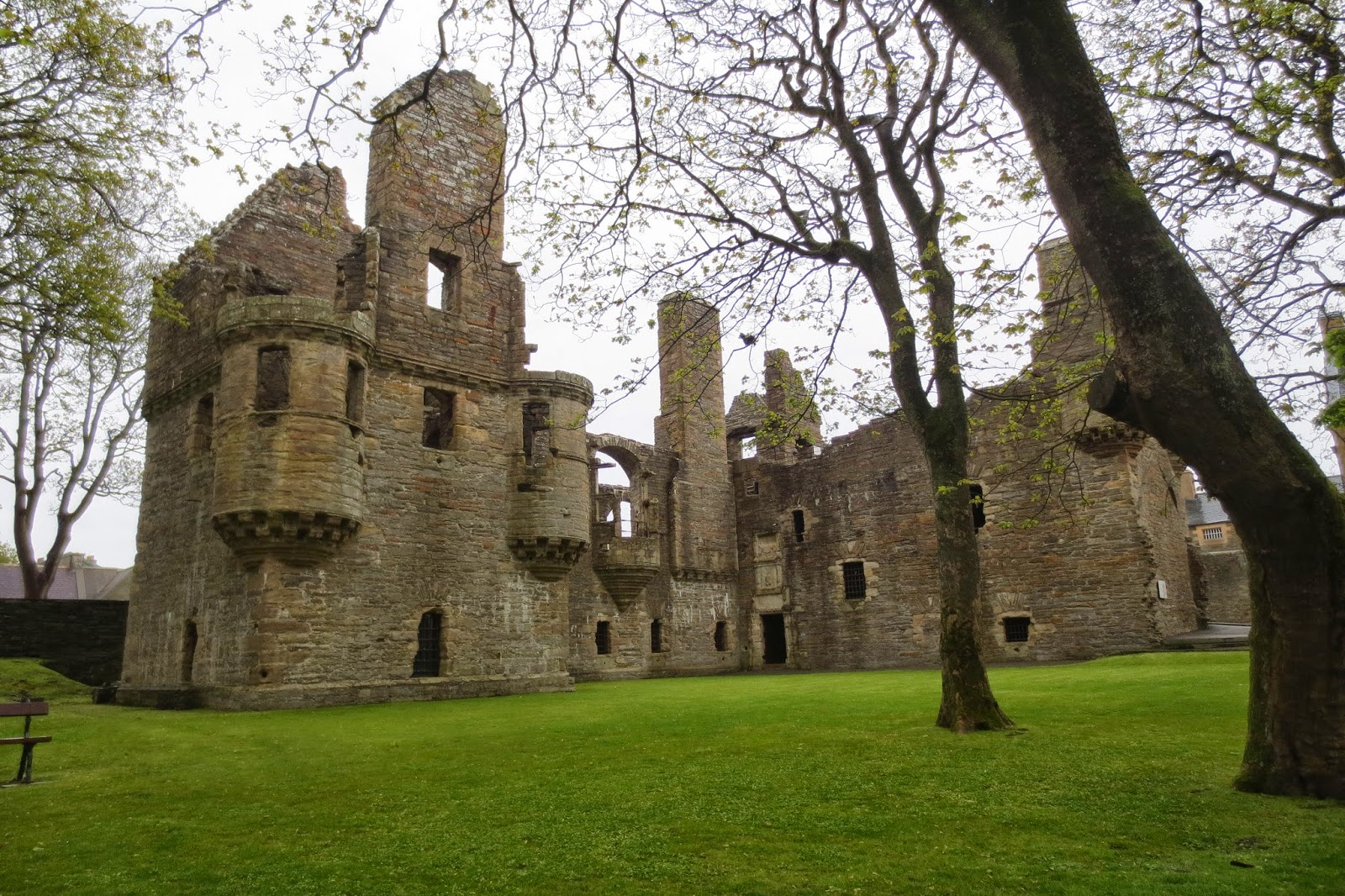
4. The Earl's Palace, also in Kirkwall, belonged to Earl Patrick Stewart, who increased taxes on the poor so he could live extravagantly. Fortunately, he got his comeuppance when he was executed for treason in 1615. Imagine applying that same punishment to our present-day politicians who try to penalize the poor to further enrich the already rich.

We were hoping to hear some traditional Orkney music tonight, but the show was sold out. We're going there tomorrow night (early!) to hear their free concert with accordian and fiddle.

The ice cream here is very tasty, and we can't get enough of it. I'm likely to be a couple sizes larger by the time we get back.


Monday, May 18, 2015

May 18, 2015

 On the biggest Orkney Island, called Mainland, sheep gnaw on grass; winding, hilly, two-way roads are only one lane (with plenty of "Passing Places" if you see a car coming towards you); trees are non-existent; one-story houses are made out of sturdy stone, stucco, or brick; and neolithic standing stones and other sites can be found in farmers' fields, where you have to step around sheep poop.

And we are at the Standing Stones Hotel near Stenness. On the drive up the east coast of Scotland yesterday, we spotted tufts of golden gorse dotting the hillsides, more sheep, picturesque villages, long and low stone walls around fields that have likely been there for centuries..

I have to revise my perspective of Scottish weather. We've had respectable periods of sunshine for the last few days, even though rain was predicted. Last night near John O'Groat, walking to The Stacks (rocky crags that birds like), we were treated to a double rainbow.

After we got off the car ferry this morning, we saw the Tomb of the Eagles. We had to lie on our backs on a flat cart with wheels and pull ourselves inside. If you look at the photo at right,
you can see a human skull. -- Like a lot of the archaeological finds in the area, it's estimated at 5,000 years old.

A few of the standing stones (the Stones of Stenness and the Ring of Brodgar) had initials scratched into them. One was "W.D. 1880." These stones are believed to be older than Stone Henge; they're also significantly smaller. The explanation for the stones is that they had ceremonial purposes. (I suspect that's the default explanation archaeologists fall back on when they have no clue.) The stones are drawing tourists, which has to boost Orkney's economy.

There are plenty of baby lambs in the area--very cute, especially when they're running. I'd like to take one home as a pet., but Customs would probably object. So would Tom.


Saturday, May 16, 2015

May 16, 2015


In Scotland, sunshine seems to be scarcer than underwear on kilt wearers, but the sun shone this morning for a couple of hours. We were grateful for it.

At the National Museum of Scotland, we saw a replica of the tomb of Mary Queen of Scots. It made me think of the elaborate sarcophagi we saw in Istanbul. It may be impressive to look at, but a fancy tomb doesn't make you any less dead.


We also saw a few of the Lewis Chess Pieces, which Tom and I had read about in one of Peter Mays's novels (titled Chessmen, appropriately enough). In the 19th century, more than 90 of these 12th century pieces were found on the Isle of Lewis. We saw 11 pieces at the museum; the rest are in the British Museum. The ones we saw all looked tired.

Naturally, we had to see the Edinburgh Castle. We went to the apartments of Mary Queen of Scots and other royalty; they had insanely high ceilings and vast fireplaces. Still, I imagine it was drafty and maybe even rat-infested. -- The castle was also used to house prisoners, who lived in cold, cramped, damp cells. Eventually, they got running water and community bathroom. A certain political party would probably think they were being coddled.

But the most fun was the City of the Dead tour. A lively young woman led our group of about 25 on an hour-and- a-half graveyard tour through Grey Friars cemetery this evening. -- More than 20 years ago, a homeless man, seeking shelter, broke into the tomb of George MacKenzie (sp.?), also known as "Bloody MacKenzie." (What else?) He had reportedly imprisoned, tortured, and killed lots of covenanters over differing religious perspectives. Our guide claimed that there has been paranormal activity since then, and that people on these tours occasionally experienced strange phenomena, such as the feeling of a hand around someone's throat or a vague sense of discomfort.


This tour was not recommended for people with heart trouble. I thought of all those cheesy horror movies in the late '50s and early '60s, how they'd have theater-goers sign a waiver in case they got so scared they got a heart attack and died. No one in our tour had a heart attack or died. However, the photo Tom took of me inside one of the crypts turned out blurry, and we're attributing that to a malevolent supernatural entity.